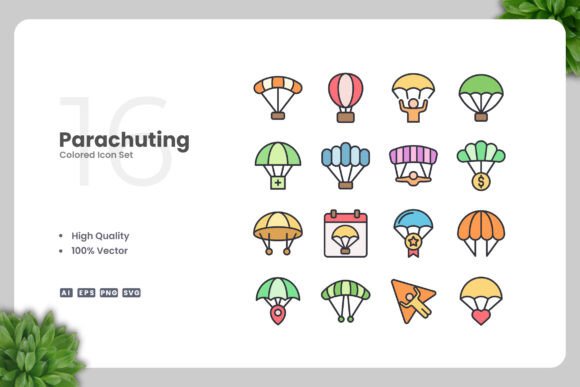
Parachuting Colored Icons: A Designer's Stitch Review
As a designer who spends more time staring at stitch simulations than actual skydivers, I approach new machine embroidery design files with a specific set of criteria. It is not just about whether the image looks cute on a screen; it is about how those lines translate into thread, how the density sits on fabric, and whether the final finished product holds up to the scrutiny of a paying customer. Recently, I evaluated the Parachuting Colored Icons collection to see if these graphics could transition from digital assets to tangible, high-quality embroidery projects.
The first impression of Parachuting Colored Icons is one of playful simplicity. The visual personality is clean and modern, avoiding the clutter that often plagues icon sets intended for print. For an embroiderer, this is immediately promising. Complex gradients and microscopic details are the enemies of the needle, but these icons appear to rely on bold shapes and clear silhouettes. The theme suggests movement and adventure, making them naturally suited for active lifestyles, outdoor gear, or whimsical children's items. However, because the product description highlights their utility for websites and apps, my primary concern was verifying if this "screen-first" aesthetic would survive the texture of thread.
Real-World Application: The Custom Tote Bag Test
To truly gauge the potential of these Icons and Graphics, I envisioned a specific real-life scenario: a custom order for a local boutique needing a series of branded tote bags for a summer market. The client wanted something cheerful but professional. I selected one of the parachuting figures from the set to test as a tote bag design.
In this context, the clean lines of the design shine. When translating a vector graphic to an embroidery file, the lack of excessive detail means fewer jump stitches and a cleaner backside. For a tote bag, which undergoes significant stress and handling, a design with lower stitch density in non-critical areas is ideal to prevent fabric distortion. The parachuting motif adds a dynamic element to what is usually a static canvas. If executed with a vibrant thread colors palette against a natural canvas or heavy cotton, the result is a handmade product that feels bespoke rather than mass-produced. Customers are drawn to items that tell a story, and a well-stitched icon of a parachutist suggests freedom and fun, increasing the perceived value of the bag.
Versatility Across Apparel and Home Decor
Beyond tote bags, the adaptability of Parachuting Colored Icons extends to various substrates. For sweatshirt embroidery, these graphics work exceptionally well on the chest or sleeve. The simplicity ensures that even on fleece or French terry, where fabric texture can swallow fine details, the shape remains recognizable. This makes them a strong candidate for custom apparel lines targeting younger demographics or sports teams.
I also considered their use in baby embroidery. Nursery decor often benefits from soft, friendly imagery. A parachuting animal or character, when scaled down appropriately, could serve as a delightful accent on a onesie or a blanket corner. However, this requires careful attention to scale. What looks crisp on a monitor might become a dense blob if stitched too small on a delicate knit. For holiday embroidery or gift items, these icons offer a neutral yet engaging theme that isn't tied to a specific season, allowing crafters to keep them in rotation year-round.
For the Etsy seller or owner of a small shop product line, consistency is key. Using a cohesive set of icons across different items—say, a matching set of aprons, tea towels, and patches—creates a strong brand identity. The visual clarity of these designs supports brand consistency, making your booth at a craft fair or your online storefront look professional and curated.
Critical Considerations for Execution
While the design potential is high, practical execution requires vigilance. There are specific scenarios where Parachuting Colored Icons must be used with caution. First, consider the hoop size. If you are working with a small hoop, such as on a cap or a infant garment, you must ensure the design scales down without losing its defining features. Tiny details in the parachute lines or the figure's limbs might vanish or cause thread breaks if the resolution isn't sufficient for the reduced size.
Fabric choice is another critical variable. On stretchy fabrics like jersey knits, a dense fill stitch can cause puckering. Since these are described as simple icons, they likely rely on solid fills. It is advisable to use a high-quality stabilizer, perhaps even a cut-away for garments that will be washed frequently, to maintain the integrity of the shape. For dark fabrics, the contrast of the thread colors becomes paramount. You may need to adjust the digitizing to include an underlay that prevents the background fabric from peeking through the stitches, ensuring the icon pops.
Curved surfaces, such as caps, present another challenge. The geometry of a parachute is inherently rounded, which can work in your favor, but stitching on the front panel of a hat requires precise positioning to avoid distortion. Additionally, if the design includes any text or extremely fine lines (which sometimes happens in icon sets), these should be avoided on textured towels or looped fabrics where the needle can get lost.
Enhancing Value and Professionalism
The ultimate goal of using a pre-made design is to elevate the finished product. When done correctly, Parachuting Colored Icons contribute to customer trust. A clean, well-executed stitch signals quality. Conversely, a poorly chosen or badly stitched icon can make a product look cheap. The visual appeal of these graphics lies in their balance; they are detailed enough to be interesting but simple enough to be durable. This balance directly impacts buyer engagement. In a sea of generic designs, a thoughtfully applied icon on a personalized gift stands out.
For those creating printable mockup files or design assets for digital sale, the versatility of the source vector allows for easy color changes to match trending palettes. However, remember that what works digitally does not always translate linearly to thread. A gradient in a vector file must be converted to distinct thread colors, which requires a keen eye for color theory to maintain the design's depth without muddying the stitch count.
Practical Notes for the Embroidery Designer
Before committing to a production run or listing a new item in your craft business, follow these practical steps:
- Test on Scrap Fabric: Always stitch a sample on the exact fabric you intend to use. This reveals issues with tension and density that screens cannot show.
- Check Thread Contrast: Ensure your chosen thread colors provide sufficient contrast against the fabric, especially for the outlines of the parachute and figure.
- Review Stitch Density: If the design feels too stiff after stitching, consider reducing the fill density in your editing software to improve drape, particularly for apparel.
- Inspect Small Details: Zoom in on the stitched sample. Are the tiny lines of the parachute cords clear, or do they merge? Adjustments may be needed for smaller sizes.
- Mockup in Black and White: View the design in grayscale to check if the values hold up without relying on color. This ensures the shape is strong enough to stand alone.
- Verify Licensing: Since these are marketed for various uses, confirm the license terms regarding commercial embroidery. Ensure you are permitted to sell physical items or digital adaptations derived from these files.
- Stabilizer Selection: Match your stabilizer to the fabric weight. Heavy designs on light fabric require robust support to prevent sagging over time.
In conclusion, Parachuting Colored Icons offer a solid foundation for creative entrepreneurs looking to add a touch of whimsy to their repertoire. They bridge the gap between digital trendiness and tactile craftsmanship. However, their success relies entirely on the skill of the operator to adapt them to the physical constraints of thread and fabric. By respecting the limitations of the medium and testing thoroughly, these graphics can become the centerpiece of profitable, beloved embroidery projects.